酶聯(lián)生物經(jīng)過不斷的實(shí)驗(yàn)優(yōu)化和改進(jìn),積累了大量的經(jīng)驗(yàn),擁有專業(yè)的酶聯(lián)研發(fā)團(tuán)隊(duì)。利用專業(yè)的酶聯(lián)免疫技術(shù)自主研發(fā)的elisa試劑盒,能對血清及其它樣本定量檢測抗原,定性檢測特異性抗體。優(yōu)質(zhì)的試劑,先進(jìn)的儀器和正確的操作是保證ELISA檢測結(jié)果準(zhǔn)確可靠的必要條件。ELISA檢測的方便性、穩(wěn)定性、重復(fù)性和可靠性方面都具有很大的優(yōu)勢。
ELISA檢測技術(shù)服務(wù)內(nèi)容:
1、雙抗體夾心法檢測抗原 2、間接法檢測抗體 3、為客戶提供各種ELISA技術(shù)進(jìn)行樣本檢測。
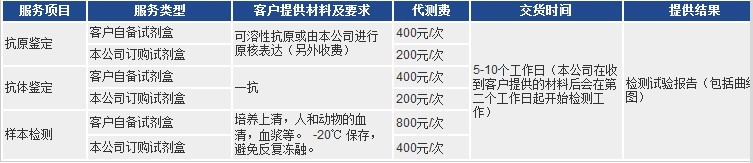
以上代測費(fèi),凡購買本公司試劑盒,我們免費(fèi)代測!
凡購買本公司目錄任何一種酶聯(lián)免疫檢測試劑盒,您只需將需要檢測的動(dòng)物(Human, Rat, Mouse, Rabbit, Monkey,
Pig……)種類和檢測指標(biāo)(白介素類、激素類)及標(biāo)本數(shù)量(48T/96T)通知公司業(yè)務(wù)員即可。在接到客戶標(biāo)本當(dāng)日起,現(xiàn)貨產(chǎn)品一周內(nèi)將檢測報(bào)告交到客戶手中!
歡迎各科研單位在各種項(xiàng)目上與我們公司開展不同層次的密切合作,以雙贏求發(fā)展,共同進(jìn)步,為中國檢測事業(yè)的發(fā)展積累經(jīng)驗(yàn)。
二、樣本要求
在收集標(biāo)本前都必須有一個(gè)完整的計(jì)劃,必須清楚要檢測的成份是否足夠穩(wěn)定。我們提倡新鮮標(biāo)本盡早檢測,對收集后當(dāng)天就進(jìn)行檢測的標(biāo)本,及時(shí)儲(chǔ)存在4℃?zhèn)溆茫缬刑厥庠蛐枰芷谑占瘶?biāo)本,請?jiān)炷H〔暮螅瑢?biāo)本及時(shí)分裝后放在-20℃或-70℃條件下保存。因冰室與室溫存在一定溫差,蛋白極易降解,直接影響實(shí)驗(yàn)質(zhì)量,所以避免反復(fù)凍融。代測放免標(biāo)本的客戶取材前須向我司銷售人員索要說明書,具體操作注意事項(xiàng)請與我司技術(shù)人員溝通。
液體類標(biāo)本:標(biāo)本必須為液體,不含沉淀。包括血清、血漿、尿液、胸腹水、腦脊液、細(xì)胞培養(yǎng)上清、組織勻漿等。
血清:室溫血液自然凝固10-20分鐘后,離心20分鐘左右(2000-3000轉(zhuǎn)/分)。收集上清。如有沉淀形成,應(yīng)再次離心。
血漿:應(yīng)根據(jù)試劑盒的要求選擇EDTA、檸檬酸鈉或肝素作為抗凝劑,加入10%(v/v)抗凝劑(0.1M檸檬酸鈉或1%heparin
或2.0%EDTA.Na2)混合10-20分鐘后,離心20分鐘左右(2000-3000轉(zhuǎn)/分)。仔細(xì)收集上清。如有沉淀形成,應(yīng)再次離心。
尿液、胸腹水、腦脊液:用無菌管收集。離心20分鐘左右(2000-3000轉(zhuǎn)/分)。仔細(xì)收集上清。如有沉淀形成,應(yīng)再次離心。
細(xì)胞培養(yǎng)上清:檢測分泌性的成份時(shí),用無菌管收集。離心20分鐘左右(2000-3000轉(zhuǎn)/分)。仔細(xì)收集上清。檢測細(xì)胞內(nèi)的成份時(shí),用PBS(PH7.0-7.4)稀釋細(xì)胞懸液,細(xì)胞濃度達(dá)到100萬/ml左右。通過反復(fù)凍融,以使細(xì)胞破壞并放出細(xì)胞內(nèi)成份。離心20分鐘左右(2000-3000轉(zhuǎn)/分)。仔細(xì)收集上清。保存過程中如有沉淀形成,應(yīng)再次離心。
組織標(biāo)本:切割標(biāo)本后,稱取重量。加入一定量的PBS,緩沖液中可加入1μg/L蛋白酶抑制劑或50U/ml的Aprotinin(抑肽酶)。用手工或勻漿器將標(biāo)本勻漿充分。離心20分鐘左右(2000-3000轉(zhuǎn)/分)。仔細(xì)收集上清置于-20度或-70度保存,如有必要,可以將樣品濃縮干燥。分裝后一份待檢測,其余冷凍備用。
三、寄標(biāo)本時(shí)需注明以下情況:
1、標(biāo)本編號(hào);2、所測項(xiàng)目;3、是否做復(fù)孔;3、聯(lián)系方式;4、實(shí)驗(yàn)后標(biāo)本是否寄回。
客戶須知:
客戶應(yīng)對所提供的材料及信息負(fù)責(zé),如因客戶提供的材料及信息不準(zhǔn)確而引起的實(shí)驗(yàn)延誤或經(jīng)濟(jì)損失由客戶承擔(dān)。
Q:1.
how to collect samples and preparation of ELISA?
Performed by ELISA test is generally common clinical samples including blood (finger
blood, blood), urine, feces, cerebrospinal fluid, pleural effusion, prostatic fluid,
semen, vaginal secretions, which
Some time of sample collection, preservation methods and has certain requirements.
Collection (a) clinical specimens
A, blood samples:Some physiological factors, such as smoking, eating, exercise, mood
swings, pregnancy, postural changes in blood can affect certain ingredients, even some
of diurnal variation. Therefore, blood samples
Acquisition should avoid interference physiological factors, consistent with appropriate
conditions, such as can not be avoided, should indicate the factors on the specimen.
1. Peripheral:Usually select the inside of blood left ring finger, the portion should be
no frostbite, inflammation, edema, damage. If the site does not meet the requirements to
other parts of the fingers instead. For burn patients, optional leather
Intact skin at the blood. As part of routine blood tests (eg, white blood cell count,
sort, etc.) affected by physiological factors fluctuation is too large, when compared to
the conditional should be consistent. It relates to the body, blood clotting function
Can test items (such as platelet count, bleeding time or clotting time) testing, we must
pay attention to understand whether the patient used anticoagulant, procoagulant drugs
in order to reduce or avoid interfering factors
influences.
2. Blood:In addition to involving a variety of projects such as hemostasis and
thrombosis detector requires the use of anticoagulated blood plasma, the current
analysis to detect the vast majority of projects can be directly detected using blood
serum. In the serum test items
, Some (such as blood sugar, blood fat) diet and circadian factors influenced, fasting
blood samples were generally appropriate; some decay rapidly in the blood (serum enzyme
activity assay such as ACP activity, etc.),
0 ~ 4 ℃ storage is not an activity decreased, the detection of these projects must be
timely and fast; some (such as creatine kinase) influenced by exercise and other
factors. Avoid hemolysis occurs when blood is also important
And, more particularly potassium, LDH and other measurement.
B, urine samples:With the same blood samples, urine samples affect diet, exercise,
medication and other factors that are also large, especially on the diet, so the morning
urine generally superior to random urine. Means getting up early morning urine
After the first urine specimens, representing concentrated and acidified visible
components (such as blood cells, epithelial cells, tubular) easy to observe the relative
concentration. Random urine that is a random urine specimens convenient, but by diet,
Sports, and even more the influence of drugs, prone to false positive and false negative
results, such as diet proteinuria, glucosuria diet, vitamin C interference occult blood
results and the like. Postprandial urine (patient 2 hours after lunch, collected
Human Urine) suitable for urine, urine protein and urobilinogen check urine samples at
this time to increase the sensitivity of the test, the detection of minor lesions. 12
hours in urine cell count is Addis count (last night 8:00
After emptying the bladder to all specimens of urine 8 o'clock the next morning),
because a long time, easy to breed bacteria shall be added preservative formaldehyde.
24-hour urine (the first day of the morning after emptying the bladder specimens from
8:00 to 8:00 the next morning
All urine) quantification of chemical substances, including proteins, sugars, urinary
17-one, 17-hydroxy steroids, catecholamines, Ca2 +, etc., to detect different
substances, choose a different preservative preservative. clean
Urine used for urine bacterial culture requires sterile specimens were taken after
washing the vulva. Urine specimens should be enough to collect all, at least 12 ml,
preferably 50 ml, the timing must collect all the urine of women
Patients should avoid vaginal secretions, blood contamination of urine specimens.
C, stool samples:Stool samples for the detection judgment digestive diseases has
important reference value. Collection requirements with a clean bamboo select faecal
mucus, pus and blood components and other abnormality, no abnormal appearance
Droppings shall be drawn from multiple surface and deep manure end. Get parasitemia and
for egg counts should be collected 24 hours feces. Dysentery amoeba trophozoites check
should immediately check in after a bowel movement, and from there sepsis
Softer at the drawn, insulation inspection. Charles S. japonicum eggs should take mucus,
pus and blood portion 30g stool specimens from at least miracidia hatching, and to be
treated as soon as possible. Check pinworm eggs must use transparent film swab
Night before 12:00 or early in the morning from defecation wrinkled folds around the
anus and immediately swabbing at microscopic examination. Occult blood test (chemistry),
fasting before the test on the 3rd of meat and foods containing animal blood and ban
clothing iron, vitamin C and so on.
Should be checked in all 1 hour stool specimen collection is completed, in order to
prevent damage to physical components of digestive enzymes and pH by. For clinical
samples above the detection indicators.
D, CSF samples:CSF samples collected immediately after submission, place too long will
affect the test results: such as cell degeneration, destruction, leading to counting and
classification are not allowed; some chemicals such as glucose content will decompose
Save
Less; bacteria occur autolysis affect bacteria detection rate. Cerebrospinal fluid
extracted three general dispensing a sterile tube, the first tube for bacterial culture,
a second tube for chemical analysis and immunological tests, the third tube for general
Characters and microscopic examination, three of the order should be reversed. Specimen
collection is difficult because all inspection and testing process should pay attention
to safety.
E, ascites and pleural effusion samples:CSF samples with the same attention to safety
after the specimen collection, and timely submission. Generally separated into three
tubes, one for routine cytology, a biochemical examination, a bacterial culture, in
order
CSF same is appropriate.
F, prostatic fluid sample:Prostatic fluid specimen after prostate massage by the
acquisition, directly drop when less liquid on a glass slide and timely submission shall
be taken to prevent sample evaporation to dryness, the amount collected for a long time
in a clean, dry test tube. If massage
No prostatic fluid, urine sediment can be checked after the massage.
G, semen samples:Abstinence before semen collection should be 3 to 7 days, drain the
urine after masturbation or other available methods of semen directly into clean
containers, insulation and timely submission. Due to changes in sperm production during
the day and
Large, generally should be checked 2 to 3 times (each time interval of 1 to 2 weeks) in
order to make a diagnosis.
H, samples of vaginal secretions:Vaginal samples were collected 24 hours before
intercourse should be prohibited, bath, vaginal examination, vaginal lavage and local on
the drug, etc., drawing instruments used need to be cleaned. Usually with brine-soaked
cotton swab from the vagina deep
Or rear vaginal fornix, cervical canal mouth drawn, etc., made after saline smear
vaginal secretion samples observation, women with menstrual vaginal secretions were not
checking.
2, do before each sample by ELISA experiment how to prepare?
Before collecting the sample must have a comprehensive plan must clearly be detected
component is stable enough. To be collected on the same day
Sample testing, and timely backup stored at 4 ℃. For the next day re-testing samples
frozen in a timely manner after dispensing -20 ℃ spare, conditional, preferably -70 ℃
cryopreservation standby. Avoid repeated freezing and thawing specimens
.
Liquid samples: including serum, plasma, urine, pleural effusion, cerebrospinal fluid,
cell culture supernatant and the like.
1. serum:
Coagulation at room temperature 10-20 mins, centrifugation 20 minutes or so (2000-3000
rev / min). Carefully collect the supernatant. If precipitation during storage,
Centrifugal again.
2. Plasma:
EDTA should be selected according to the requirements of the specimen, sodium citrate or
heparin as an anticoagulant, mix 10-20 mins, centrifugation 20 minutes or so (2000-3000
rev / min). Carefully collect the supernatant. Save process
If precipitation appeared, Centrifugal again.
3. Urine:
Sterile collection tube. Centrifuged for 20 minutes or so (2000-3000 rev / min).
Carefully collect the supernatant. If precipitation during storage, Centrifugal again.
Pleural and peritoneal effusions, and cerebrospinal fluid Reference to this practice.
4. The cell culture supernatant:
The detection of secretory component with a sterile collection tube. Centrifuged for 20
minutes or so (2000-3000 rev / min). Carefully collect the supernatant.
5. cultured cells
????When the detection of intracellular components, diluted with PBS (PH7.2-7.4) cell
suspension, the cell concentration reached 1 million / ml or so. By repeated freezing
and thawing or tissue protein extraction reagent was added to the cells
Damage and release of intracellular components. Centrifuged for 20 minutes or so
(2000-3000 rev / min). Carefully collect the supernatant. If precipitation during
storage, Centrifugal again.
6. tissues
????After cutting samples, check the weight. Adding a certain amount of PBS, PH7.4.
Rapidly frozen with liquid nitrogen. After thawing samples remained at 2-8 ℃. Adding a
certain amount of PBS
(PH7.4), or tissue protein extraction reagent, or by hand homogenizer homogenized
sample. Centrifuged for 20 minutes or so (2000-3000 rev / min). Carefully collect the
supernatant. A new package to be detected, which
I alternate freezing.
Q:Do
I have to run all of my standards and samples in duplicate?
A:Yes, the duplicates are run in order to monitor assay precision and increase
confidence in the assay results obtained.
Q:Do
I have to run all of my samples at one time?
A:No, each kit uses stripwell microplate. This allows the user to analyse different
numbers of samples at different times.
Q:What
types of reproducible results are obtained with the assays?
A:Each kit comes with a manual containing a graph of typical data obtained. Any
variation in operator, pipetting and washing technique, incubation time or temperature,
and kit age can cause variation in result. Each user should obtain their own standard
curve.
Q:Is
it possible to store the reagents other than indicated?
A:Storage of the kit components under conditions other than indicated is not recommended
in order to assure proper performance of the test.
Q:How
should I store my samples?
A:Samples should be stored at -20oC or lower temperature. For long-term storage, it is
recommended to freeze them at -70oC -80oC.
Q:Can
I modify the protocol?
A:BG ELISA kits have been optimized to provide the best possible results. Modifying the
format or protocol may give inaccurate and wrong results.
Q:Can
I use a sample type that is not recommended in the kit insert?
A:The kit has been validated for the sample types listed in the kit insert. Sample types
other than those validated have not been tested. Contact Technical Service for further
information.
Q:My
samples generated values that were outside the dynamic range of the assay. Can I use
these values?
A:It is recommended that only sample values that fall within the range of the standard
curve be used. Values outside the range of the standard curve are generally non-linear,
which can lead to incorrectly extrapolated values. Samples that generate values higher
than the highest standard should be (further) diluted and the assay repeated. If samples
fall below the range of the assay, the sample is considered to be non-detectable.
Q:Do
I have to run a Blank or Zero Standards every time?
A:Yes, these are required for the calculations, and reflect any subtle but significant
performance changes from day to day and assay to assay. They are also extremely helpful
when troubleshooting the source of a particular assay problem.
Q:Can
I alter the volume of sample I use in the assay?
A:It is not recommended that you alter the volumes since all BG kits are designed for
optimal performance at the given volumes
Q:Can
components from different kits be used?
A:Each kit contains components which have specific lot numbers to ensure that all of the
components are performing optimally alone, as well as with all of the other components
in the kit. QC testing is performed on these specific lots. It is never recommended to
use your own components or components from other kits or vendors.
Q:My
standard curve looked fine, but I didn’t get a signal in my sample when I expected
to, why?
A:The sample may not contain the analyte. A matrix effect may be masking the detection.
Ensure that the recommended dilution was followed as stated in the kit insert. If
dilution was recommended, check to be sure that the dilution was performed properly.
Over-dilution may cause the sample to fall below the range of the standard curve.
Q:How
do you recommend I wash my plate?
A:If you are using an automated plate washer we recommend that the calibration be
checked on a regular basis, and that the system is flushed with the Plate Washing Buffer
prior to washing. The same is true for a manual washer. A repeater or a wash bottle can
also be used. The user should be careful to ensure that all of the contents are
aspirated and the plate tapped dry on lint-free paper.
Q:Do
I need to use a plate shaker?
A:Reliable results can be obtained without a plate shaker, but the O.D.'s will generally
be lower than those obtained using a plate shaker.
Q:Why
do I have to use wavelength correction between 450-570nm?
A:For the ELISA assay, reading at dual wavelengths is done to correct for the optical
density contributed by the plastic well, the lamp and optical fluctuations.
Q:If
I extract my sample, do I still need to follow the recommended dilutions given in
the kit insert?
A:The amount of sample dilution needed after an extraction procedure will be affected by
the effects of purification and concentration in the protocol used. The amount of
dilution or concentration will have to be determined by the end-user.
Q:What
is the expected concentration of analyte that I should expect to find?
A:The amount of a given analyte may vary not only from species-to-species, but also
between tissue and cellular sources. The best source of this information is the current
literature that is easily accessed through the Internet at multiple scientific
databases.
Q:My
optical densities were a little higher (or lower) than those in the manual that came
with my kit. Why?
A:The optical density is affected by a number of physical conditions such as time and
temperature. We suggest that you shorten or lengthen the final incubation with substrate
solution to compensate.
Q:What
are the reasons for High Background?
A:1) Improper Washing: Check volume of washing buffer reservoir and make sure all
recommended washing steps are performed.
2) Contaminated Substrate: Make sure there is no contamination of the substrate with
metal ions or oxidizing reagents, before use. Keep the extra substrate solution
separately during the ELISA substrate development time.
3) Substrate exposed to light: Exposure to light may result in a blue color of the
substrate. Keep solutions in the dark (vial) until ready to dispense into the plate.
4) Wrong Incubation Times/Temperatures: Generally follow the test protocol regarding
incubation times and temperatures. However, if all wells are intensely and equally
colored with no intensity gradient observed in the standard dilution series, then it may
be necessary to observe the substrate reaction as the color is developing, in order to
stop the reaction sooner.







 找尋抗體,試劑,細(xì)胞裂解液,試劑盒






 酶聯(lián)官方手機(jī)二維碼